Layered Puzzle Strategy for Calm, Clear Play
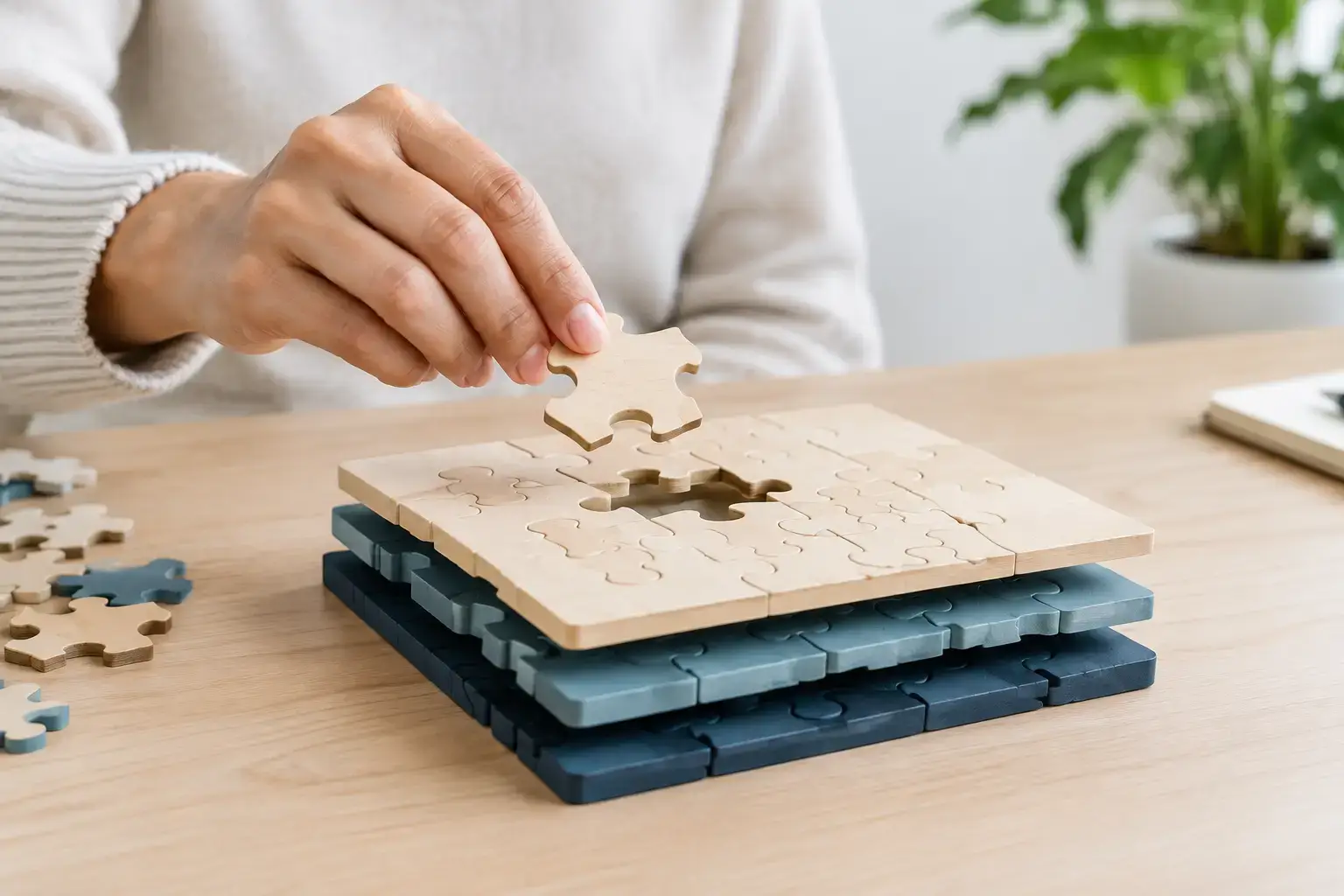
A good layered puzzle strategy begins before the first move. Whether you are placing shapes, joining colours, tracing paths or arranging letters, the board is rarely asking for the nearest match alone. It is asking you to notice what that match will change.
That small shift makes a puzzle feel less like a test of speed and more like a quiet conversation. One move clears a corner. The cleared corner makes room for a larger piece. That piece opens a route you could not see at first. Progress arrives in layers, often with a satisfying click when the pattern finally settles into view.
What makes a puzzle layered?
A layered puzzle has more than one thing happening at once. There may be an immediate goal, such as matching three tiles or fitting a shape into a gap, alongside a longer-term concern: keeping space open, building a chain, saving a useful piece or avoiding an awkward edge.
The trick is that these concerns can disagree. The move that scores points now may leave a sharp corner that cannot be filled later. The move that appears modest may preserve a bright gap at the centre of the board, giving you several better options on the next turn.
This is why a layered puzzle rewards a little patience. You do not need to plan every move from the beginning. In fact, trying to do so can make a calm game feel fussy. Instead, hold two horizons in mind: what this move achieves now, and what it leaves possible afterwards.
The first layer: the obvious move
Start by seeing the clearest action. In a word game, it might be the word you can already read. In a shape game, it might be the piece that fits without forcing anything else. In a merging game, it may be the pair that creates space as well as a larger value.
Taking the obvious move is not careless. It gives the board a chance to change. New information often appears only after a tile is removed, a row shifts or a colour cluster joins together. The aim is not to avoid simple moves, but to make them do useful work.
Before committing, pause for a second and ask: does this move tidy the board, or merely decorate it? A tidy move reduces clutter, joins related pieces or makes future placement easier. A decorative move may look pleasing while quietly narrowing your choices.
The second layer: the shape of future space
Space is an active part of most puzzles. Empty squares, unblocked routes and flexible clusters are not nothing. They are the room in which later solutions can form.
Look especially at edges, corners and narrow channels. These are where a board becomes rigid. A single empty corner can be harmless; several mismatched corners can become a problem because they demand very particular pieces. If you can fill an awkward pocket with the right shape, it is often worth doing. If you cannot, keep the area open rather than scattering fragments around it.
A useful habit is to scan the board for pieces that only have one sensible home. Place those with care. More adaptable pieces can wait. A small square may fit almost anywhere, while a long bar or unusual angle needs a clear lane. Giving the least flexible piece priority prevents the board from slowly closing around it.
This does not mean every game should be played defensively. Some puzzles reward building a risky, satisfying arrangement before clearing it in one go. The difference is whether you can still describe the escape route. If the plan depends on drawing exactly the right piece next, it is hope rather than strategy.
A layered puzzle strategy in four quiet checks
When the board feels busy, use a short routine rather than chasing every possibility. Four checks are enough:
- Read the immediate opportunity. Find the move that clears, combines or completes something useful now.
- Notice the pressure points. Look for blocked corners, isolated tiles, nearly full rows or colours that are becoming stranded.
- Keep one flexible area. Protect a patch of board where several incoming pieces could still work.
- Choose the move with the kindest aftermath. Prefer the action that leaves the board calmer, even if another option gives a slightly larger reward this turn.
These checks are not rules carved into stone. A score-chasing arcade puzzle may ask you to accept more mess in return for a large chain. A relaxed placement puzzle may reward steady order above all else. The point is to make the trade-off visible, rather than discovering it after the board has become cramped.
Learn to spot false progress
Many puzzles are generous at the beginning. Matches are easy, gaps are wide and almost any move feels productive. The more interesting decisions arrive when the board starts to carry history.
False progress is a move that looks successful because it creates an animation, a score increase or a pleasing little burst of colour, but leaves the underlying position worse. It can happen when you repeatedly clear from the centre while the edges harden, or when you merge the first available pair without considering the value it will create.
The answer is not to become suspicious of every reward. It is to notice whether the board has gained options. After a strong move, you should be able to point to something newly possible: a clear row, a larger connected group, a released corner or a safer place for the next piece.
If nothing has opened up, consider whether you have been treating the puzzle as a series of separate turns. Layered play connects turns together. Each one should leave a small note for the next.
Do not confuse waiting with planning
There is a gentle trap at the other end too: waiting for the perfect move. Some players see a possible chain and refuse to touch the board until every part of it is ready. Meanwhile, useful space disappears and the position loses its shape.
Planning has a reason. You might delay a match to bring in one more tile, keep a colour group intact or save a tool for a genuinely difficult section. Waiting without a reason is simply postponing the decision.
A good test is to say the plan plainly. “I am leaving these two blue pieces because the next blue tile will make a larger cluster.” That is a plan. “I am not sure, but this might become useful” may be enough for one turn, not five.
Let the board set the pace
Layered puzzles often become harder when played too quickly, not because quick fingers are wrong, but because speed hides the board’s structure. A pause of two seconds can reveal that a piece has another home, or that the attractive move closes the only open route.
There are moments for instinct. Once you have played a particular puzzle for a while, your eye begins to recognise stable shapes and dangerous gaps without needing a running commentary. That instinct is earned through repetition, and it should feel light. You are not trying to calculate a hundred moves ahead on a train journey home.
Try playing a few turns with a different goal from the usual one. Ignore score for a moment and aim to keep the centre open. Or try to make every move create space. Or decide that no corner may be left with a single unmatched tile. These small self-set constraints teach you what the puzzle values, and can make a familiar board feel fresh again.
Recovering when the plan breaks
Eventually, the wrong piece appears. A promising line closes. A rushed tap creates the one shape you did not want. Recovery is part of layered puzzle strategy, not evidence that the strategy failed.
First, stop trying to restore the exact plan you had. The board has changed, so your priorities should change with it. Find the most restricted area and make it less restricted. Clear a route, join an isolated piece, or use a flexible tile to soften a hard edge. One unglamorous repair move can be more valuable than another ambitious chain.
Then look for a new centre of gravity. Perhaps the left side is now your useful open area, or perhaps a colour group that was once secondary has become the cleanest route forward. Puzzles are often more forgiving than they first appear when you are willing to let the answer change shape.
Play for the next satisfying decision
The best layered play does not always produce the biggest score or the longest chain. Sometimes it produces something quieter: a board with room to breathe, a useful piece saved for later, a difficult corner made simple.
That is a worthwhile place to stop as well as continue. Leave yourself a board you would be pleased to return to. One clear space, one possible line, one small decision waiting to come into focus can turn a spare minute into a satisfying little piece of play.