10 Games for Train Journeys That Fit the Rhythm
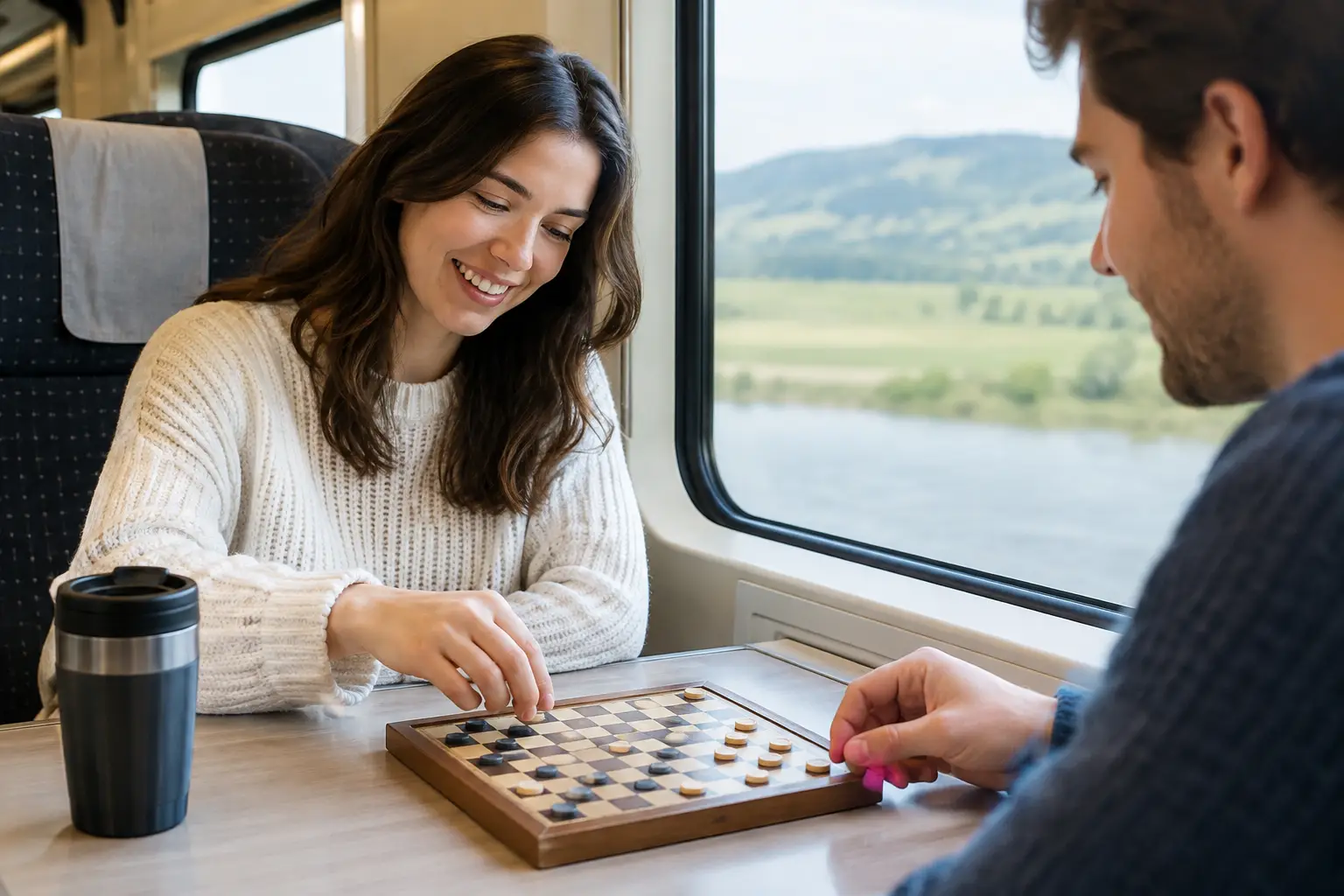
The doors close, the platform slips away, and there is suddenly a small stretch of time that belongs to you. The best games for train journeys do not compete with that feeling. They sit neatly beside the changing view, giving your hands something satisfying to do while leaving room for a coffee, an announcement, or the quiet blur of fields beyond the window.
A train is not quite a living room and not quite a queue. It asks for games that can begin quickly, pause cleanly and feel complete even when played in fragments. A good choice turns an awkward ten-minute wait at the station into a bright gap in the day. A great one can carry you gently through the whole journey without making the carriage feel any smaller.
What makes good games for train journeys?
The first test is simple: can you stop at any moment? Your stop may arrive early, someone may ask to see your ticket, or the signal may disappear halfway through a tunnel. Games with short rounds, clear checkpoints and no penalty for stepping away are particularly kind travelling companions.
Offline play matters more than it first appears. Wi-Fi can be patchy, mobile data can vanish between towns, and no one wants a game that becomes less useful the further the train gets from a city. A game that works happily without a connection feels like a small object you have brought with you, rather than another service asking to be maintained.
The screen also has to earn its place. Carriages are full of visual noise: reflections, passing light, seat fabric, route maps and other people’s screens. Clean shapes, legible text and considered colour contrast make a game easier to return to when the sun catches the window. This is not only an accessibility consideration. It is part of the pleasure of play when your attention is gently divided.
Finally, think about sound. Headphones are useful, but they are not guaranteed to be charged or packed. Games that remain satisfying when silent have an advantage. A tap, a swipe, a placed tile or a completed word should make sense through touch and movement alone.
Choose a game for the part of the journey
A long journey is rarely one continuous mood. There is the bustle of finding the correct coach, the settled middle section, and the slightly restless period before arrival. Different games suit each of these moments.
While you are waiting on the platform
This is the time for something instantly understandable. A one-touch arcade challenge, a short matching game or a compact puzzle with a single clear aim works well here. You should be able to open it, make a decision and feel the result without reading instructions over station announcements.
Fast games are not necessarily frantic games. A simple action can still have a lovely rhythm: steering through a narrowing space, placing one shape beside another, or timing a tap so that a small movement lands neatly. The best short-session games make failure feel like useful information rather than a scolding. You try again because the next attempt is already visible in your mind.
Once the train has found its pace
The middle of the journey can hold slower puzzles. Word games are especially good company when you want to focus without shutting out the world completely. There is room to look up, watch a station go by, then return and let the answer come into focus.
Choose puzzles that give you a few possible paths rather than one punishingly correct route. Rearranging letters, building chains, grouping colours or fitting shapes into a space can be absorbing without demanding total silence. They provide enough structure for a wandering mind, which is often exactly what a train journey needs.
When the journey is longer than expected
Delays are where a game’s temperament becomes obvious. An endless runner or score challenge can help time pass, but only if it does not turn every slip of the thumb into irritation. Look for a generous restart, responsive controls and progress that comes from learning a little more each time.
Creative games can be even better for this part of the ride. A small drawing tool, a colour arrangement game or an app that lets you compose something at your own pace can turn extra minutes into a pocket studio. There is no need to finish a masterpiece before the next stop. The value is in making a mark, changing your mind and seeing a blank space become yours.
Ten kinds of train-friendly play
Rather than looking for one perfect game, it helps to keep a small mix on your phone or iPad. Your choice can then match the length of the journey and the amount of attention you have to spare.
- Word puzzles reward patient observation and work particularly well in portrait orientation, with one hand free for a drink or rail.
- Shape-placement puzzles make good use of tactile dragging and turning. A satisfying fit can feel surprisingly substantial on a small screen.
- Colour-matching games offer clear visual goals and a calm rhythm, especially when their palettes are easy on the eyes.
- One-touch challenges are ideal for short waits. Their controls are easy to remember after a week away.
- Endless arcade games suit the restless part of a longer ride, when you want a little motion that you can stop without ceremony.
- Merge games give you small, rewarding progress. One tiny combination can lead to a useful new possibility a few moves later.
- Daily puzzles provide a gentle boundary. Finish one, close the app, and leave something fresh for the return journey.
- Drawing and creative apps are for making rather than winning. They are particularly nice when you have a tablet and a window seat.
- Turn-based board-style games can suit a quiet solo session, provided they save reliably and do not insist on an internet connection.
- Gentle logic games are a strong all-round choice. They ask for thought, not speed, and can be resumed after every interruption.
There are trade-offs. A visually dense strategy game may be perfect for a two-hour intercity trip but awkward on a packed commuter service. A fast reflex game can feel wonderful after a slow day at work, yet tiring if you are already motion-sensitive. The right game is often less about genre than its relationship with your attention.
Set up your phone before you leave
A few quiet preparations make a real difference. Download the game and any extra content while you are on home Wi-Fi, then open it once before setting off. This confirms that it works offline and avoids an unexpected sign-in screen when the train is already moving.
Turn on low power mode if your battery is looking uncertain, and consider lowering brightness after you have found your seat. Brightness that feels fine in a station can become harsh in a dim carriage. If you are travelling with an iPad, a stand or folded case can make a puzzle more comfortable than balancing the screen on a bag.
It is also worth choosing games that respect a private moment. Avoid titles that interrupt play with loud adverts, countdowns or demands to return at a particular hour. A train journey already has its own timetable. Your game does not need to add another.
This small-space thinking is close to the kind of play made by Tom Makes Games: focused interactions, clear rules and room for the player to set the pace. On a train, those qualities are not decorative. They are what make a game feel considerate.
Let the landscape keep some of your attention
There is no prize for filling every minute. Sometimes the nicest game for a train journey is one you play for three rounds, then put down when the light changes across the carriage. Choose something that gives you a satisfying action, a little progress and an easy way back out.
Keep a handful of games that fit different moods, let one live offline on your device, and leave enough attention for the view. The journey will feel shorter, but not rushed.