iPad Games for Quiet, Satisfying Moments
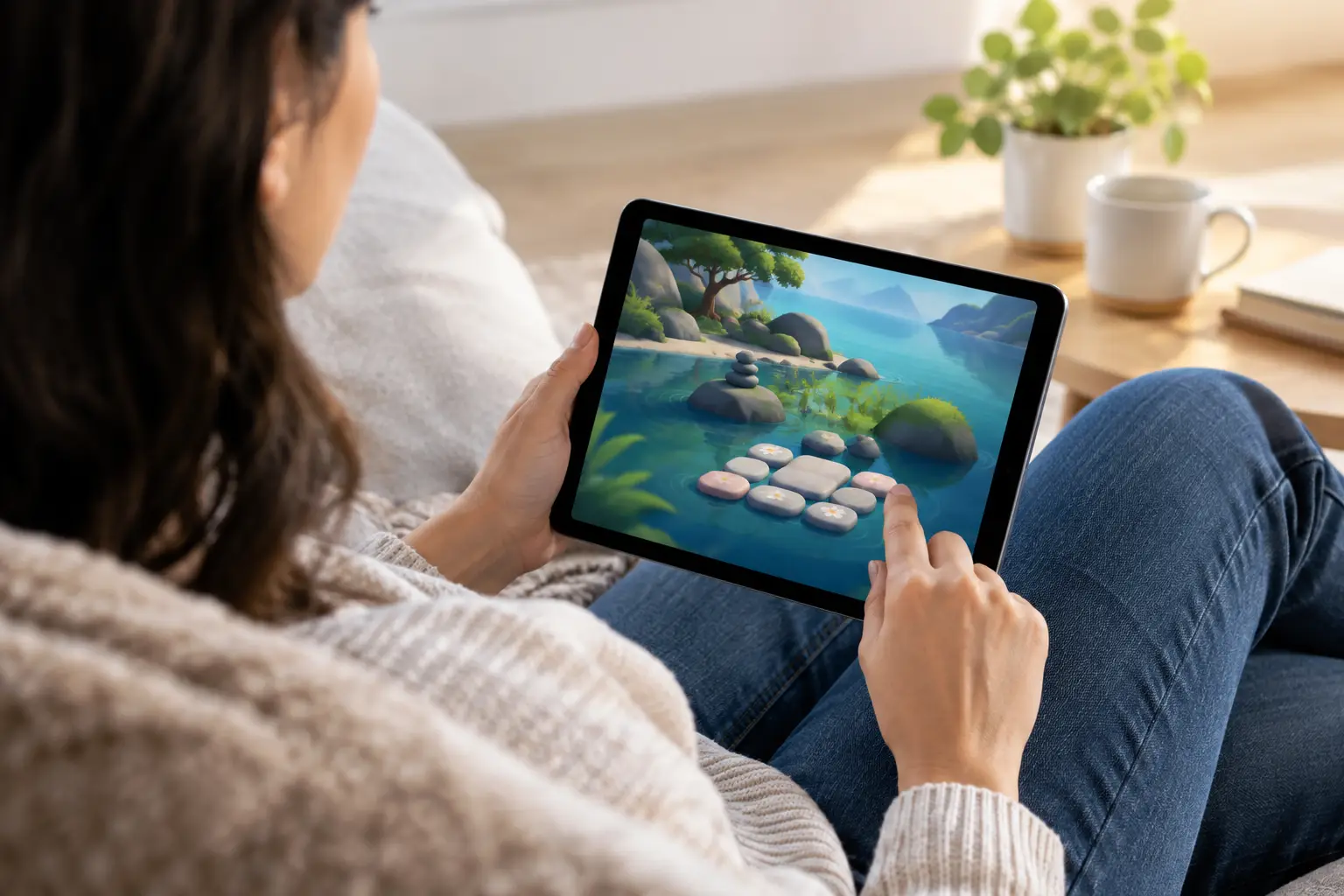
A good iPad game can change the shape of ten spare minutes. The larger screen gives a puzzle room to breathe, makes a bright piece of colour feel placed rather than merely tapped, and turns a simple swipe into a small physical gesture. The best iPad games do not need to shout for attention. They offer a clear invitation: make a word, guide a shape, find the bright gap, then stay for as long as the moment allows.
For quiet play, that distinction matters. A game can be simple without feeling thin, and relaxed without becoming aimless. The most satisfying ones give you something to notice with each move: a neat chain of letters, a clean line through a crowded field, or an arrangement that settles satisfyingly into place.
Why iPad games feel different
An iPad is not simply a larger phone. It asks for a different kind of interaction. There is space for generous buttons, crisp type, boards that are readable at a glance and gestures that feel direct under your hand. You can hold it close on the sofa, prop it up on a train table, or leave it beside a cup of tea while you work through one more puzzle.
That extra room is particularly kind to games built around looking and thinking. In a word puzzle, you can see more of the pattern before making a choice. In a colour or shape game, small differences remain visible rather than shrinking into visual noise. In an arcade game, a wider view can make movement feel less cramped, even when the challenge becomes sharper.
It does not mean every game needs a large board or detailed artwork. Often, the best use of the screen is restraint. A single object, a small palette and a precise response to touch can feel more memorable than a display filled with buttons, banners and things competing to be noticed.
What makes a good game for short sessions
Short-session games are often mistaken for throwaway games. They need not be. A well-made three-minute game has to establish its idea quickly, make your actions understandable and leave you with a sense that the time was well spent.
The first quality is immediacy. You should be able to begin without a long tutorial or a crowded menu. This does not mean there can be no depth. It means the first action explains itself. Drag the piece. Tap the match. Steer towards the opening. A good rule is that the control should feel obvious before the strategy does.
The second is a natural stopping point. A single puzzle, a short run or a newly completed arrangement gives the session a gentle edge. You can put the iPad down without being punished for leaving, while still having a reason to return later. This is particularly welcome on a commute, between tasks or at the end of a day when concentration has already done enough.
Finally, there should be rewarding progress without pressure. Progress might be a new pattern you understand, a personal high score that inches upwards, or simply a better feel for the rhythm of play. It does not always need daily streaks, countdowns or a great pile of prizes. Sometimes the reward is seeing your own decision become clearer.
The pleasure of tactile play
Touchscreens are at their best when a game respects touch as more than a replacement for a button. Sliding, placing, merging and steering can all have a particular weight, even through glass. Sound, timing and animation help, but only when they support the action rather than interrupt it.
Think of a shape settling into the right space. The movement should have a little confidence, and the response should arrive at the moment your brain expects it. Or consider an endless runner controlled with one touch. The whole game may depend on the tiny difference between a cautious press and a held gesture. That narrow control can make a simple system feel alive.
Visual clarity does much of the same work. Strong contrast, deliberate colour and clean edges help you understand what is happening before the game needs to explain it. This is not only about accessibility, though it helps there too. It is about allowing the eye to rest on the important thing.
Choosing iPad games that suit your mood
The right game depends on what sort of pause you need. A puzzle can offer calm focus, but it may be less appealing when your head is already full. An arcade challenge can clear the mind through movement, yet it may ask for more alertness than a late evening calls for.
Word games suit moments when you want a thought to take shape slowly. There is pleasure in trying a possible answer, leaving it alone, then letting the answer come into focus. Good word play leaves enough space for this. It should feel like an invitation to notice language, not a test being marked over your shoulder.
Shape-and-colour games are often more immediate. They can be useful when you want to look rather than read, making small visual decisions and enjoying the order they create. Their appeal comes from a clear relationship between action and result: place this here, join these together, make the field less tangled.
Creative games offer something different again. Instead of asking for the correct move, they give you a small set of materials and let the result belong to you. The iPad becomes your own pocket studio: a place to experiment, arrange, erase and begin again without the cost of getting it wrong.
Then there are score-chasing games. These work well when you want a quick spark of concentration. The best do not mistake difficulty for clutter. They give you one readable challenge, then gradually reveal its sharp corners. One more attempt feels tempting because you understand exactly what you might do differently.
A calmer approach to challenge
There is no single definition of a relaxing game. For some people, relaxation means an open-ended activity with no failure state. For others, it means a focused challenge with rules clear enough to hold the rest of the day at a distance.
What tends to make a game tiring is not challenge itself, but friction around it. Repeated interruptions, unclear goals, aggressive timers and crowded reward systems can make even a gentle idea feel demanding. A calm game can still be difficult. It simply treats the player fairly: failure is readable, restarting is quick, and improvement feels possible.
Offline play and a clear privacy approach matter here as well. A game for a train journey or a quiet waiting room should not suddenly become unavailable because the signal has disappeared. Equally, it is easier to settle into play when the game is not constantly trying to turn your attention elsewhere.
This is part of what makes independent games worth seeking out. A small studio can make a game around one carefully considered feeling rather than trying to satisfy every possible habit at once. Tom Makes Games approaches its work in that spirit: compact ideas, direct controls and room for the player to set their own pace.
Give the screen a little space
The iPad rewards games that are willing to be spare. It has enough room for a puzzle to feel generous, for an object to have presence and for a score to sit quietly at the edge of the screen rather than demanding celebration. When every element has a reason to be there, the game can feel calm even as it asks you to think quickly.
That is a useful way to choose what to play. Look for a game with one strong action, a clear visual voice and a pace you can control. It may be a five-minute word puzzle, a colourful arrangement or a brief run through a shifting obstacle course. The right one will not ask you to make time for it. It will make a small pocket of time feel like it was yours all along.