What Thoughtful iOS Game Reviews Should Notice
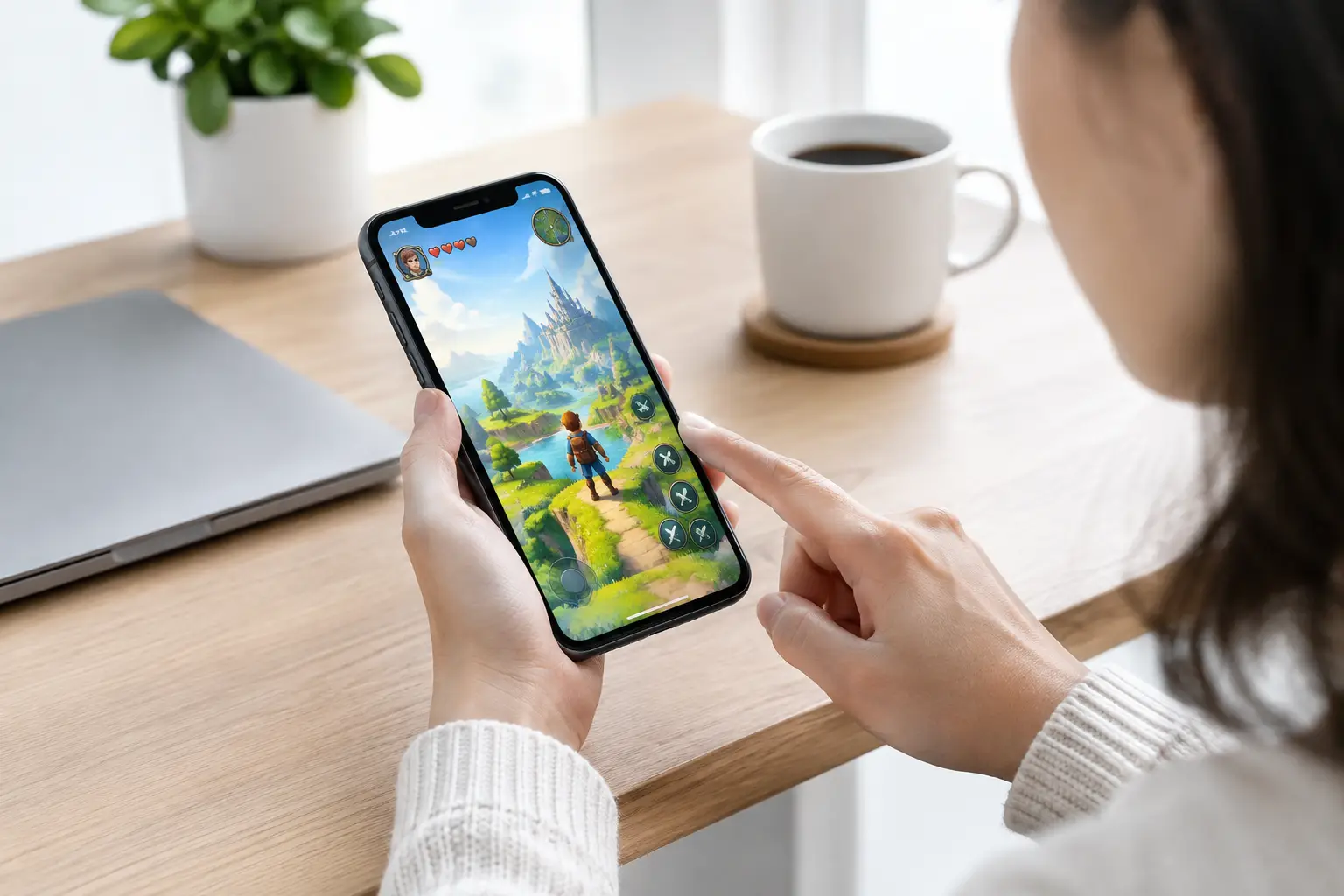
A game can fit in the minute before a train arrives, yet stay in the mind for the rest of the journey. That is the territory thoughtful iOS game reviews need to describe. Not just whether a game is good, but how it feels to return to it: the weight of a swipe, the pause before a word appears, the quiet relief of being able to stop exactly when you like.
A star rating can be useful. It cannot tell someone whether a game will suit a tired evening, a busy commute or ten clear minutes with a cup of tea. Mobile games are often judged quickly because they are played quickly. The better reviews slow down long enough to notice the small decisions that shape the experience.
Thoughtful iOS game reviews begin with the hands
An iPhone or iPad is not simply a small screen. It is an object held close, touched directly and picked up in odd little gaps in the day. A review should pay attention to what the player actually does with it.
Is the central gesture clear from the first moment? Does tapping feel crisp, or does the game ask for fiddly precision that the screen cannot comfortably provide? Does a swipe have a pleasing sense of direction and momentum? A good touch interaction can make the simplest idea feel alive. A less considered one can put sharp corners around an otherwise lovely game.
This is particularly true for games with one-touch controls. Saying that a game is “easy to play” is not enough. Easy can mean welcoming, but it can also mean shallow. The useful question is whether the control leaves room for judgement. Steering at the right moment, choosing where to place a shape, or holding on for one beat longer can create a satisfying conversation between hand and screen.
Reviews should also say when a game asks too much of the hand. Tiny targets, rushed reactions and repeated accidental taps are not minor details on a phone. They are the game’s physical texture. On iPad, the same game may breathe differently, with more room for planning and a broader, calmer surface to work across. That difference is worth mentioning rather than treating both devices as interchangeable.
Pace matters as much as challenge
Many mobile games are built around urgency: timers, streaks, alerts and ever-present reasons to come back. There is nothing automatically wrong with pressure. An arcade game may need speed to create its bright gap of excitement. But a review should identify what sort of pressure is being offered, and whether it serves the game.
A calm puzzle can still be difficult. In fact, difficulty often feels more rewarding when the game gives the player time to let the answer come into focus. Does it allow an unfinished thought to sit without punishment? Can you undo a move, take a breath, or simply close the app and return later? These are design choices, not soft extras.
Likewise, an endless runner may be designed for quick failure and immediate replay. The review should explain whether each attempt teaches something useful. Does the player learn the shape of a hazard, recognise a rhythm, or discover a better route? If failure only sends them back to the same opening seconds, the game can become noisy rather than compelling.
The best criticism does not assume that calm is always better than intense, or that a score chase is automatically stressful. It asks whether the rhythm is honest. A game should know what kind of moment it wants to occupy.
Look past the first five minutes
Screenshots are made for a first glance. Reviews are most helpful when they explain what happens after the first spark. A simple concept can open beautifully over several sessions, while a clever visual idea can run out of room after two rounds.
Progress is the key question. It does not have to mean levels, upgrades or an ever-rising number. Progress might be a growing confidence with a system, a newly noticed pattern, a collection taking gentle shape, or a personal best achieved through clearer judgement. In creative games, it may simply be the accumulation of things you have made.
A reviewer should describe the arc without flattening it into a checklist. Are new rules introduced at a useful pace? Does the game reveal deeper combinations? Is there a point where it becomes repetitive, and is that repetition soothing or merely thin? These distinctions help people choose a game for the right reason.
Short sessions deserve particular care here. A game can be brief without being slight. If a round lasts two minutes but leaves a small idea to consider, it has done more than fill time. Equally, a longer game should not demand an uninterrupted hour simply because it lives on a device that travels everywhere.
Notice the space around the game
Thoughtful iOS game reviews also examine what the game does when the player is not actively making moves. Does it fill the screen with prompts, currencies and temporary offers? Does it ask for a daily routine before it has earned one? Are there adverts that break the mood, or purchases that turn progress into a queue?
These details affect trust. A quiet game can lose its calmness the moment it interrupts a puzzle with a bright, unrelated video. A generous free game may still be worth playing, while a paid game may not suit everyone. The useful review explains the arrangement plainly: what the player gets, what costs extra, and whether the design feels complete without further spending.
Privacy and connectivity belong in this picture too. For many players, an offline game is not a technical footnote. It is something to play underground, on a flight, or in a patchy corner of a holiday cottage. If a game needs an account, collects data, or relies on a permanent connection, say so in direct language. If it works quietly without either, that is worth celebrating.
This is not about demanding that every game be identical. Online competition, live events and social play can be the point. The question is whether the surrounding systems support the intended experience or keep tugging at the player’s sleeve.
Describe the design, not only the decoration
Visual style is often reduced to “beautiful” or “cute”. Those words are pleasant but vague. A more useful review notices how design helps play. Can you immediately see what is movable, what is dangerous and what is waiting for your attention? Does colour clarify a rule, create atmosphere, or occasionally obscure important information?
Sound deserves the same attention. A small click, pop or soft chord can make an interaction feel tactile even through glass. Silence can be equally deliberate. A good review explains whether audio supports concentration, becomes repetitive, and offers sensible controls for playing in public.
Accessibility should be part of this observation, not a final courtesy paragraph. Consider readable type, contrast, reliance on colour alone, vibration, adjustable sound, left-handed comfort and the demands placed on reaction time. No single game will suit every player, and not every omission is equally limiting. Still, a review that names the limits is far more useful than one that assumes a single kind of player.
A review is a recommendation for a particular moment
The most generous reviews resist the urge to declare one universal verdict. Instead, they give the reader a clear sense of fit. This may be a fine game for someone who likes making careful choices over a few minutes, but a poor match for a player seeking a long narrative. It may be a sharp score chaser for a lunch break, not a companion for winding down before bed.
That specificity is kinder to both players and makers. It recognises that small games can have distinct ambitions. A compact word puzzle does not need the endless scale of a blockbuster to be memorable. A playful shape game can be valuable because it offers a few minutes of clear, satisfying attention.
At Tom Makes Games, that is the kind of small experience we admire: one that knows the shape of its own time. The next time you read or write a review, look for the details that reveal whether a game will make a welcome pocket-sized place in someone’s day.