Relaxing Games Versus Competitive Games for You
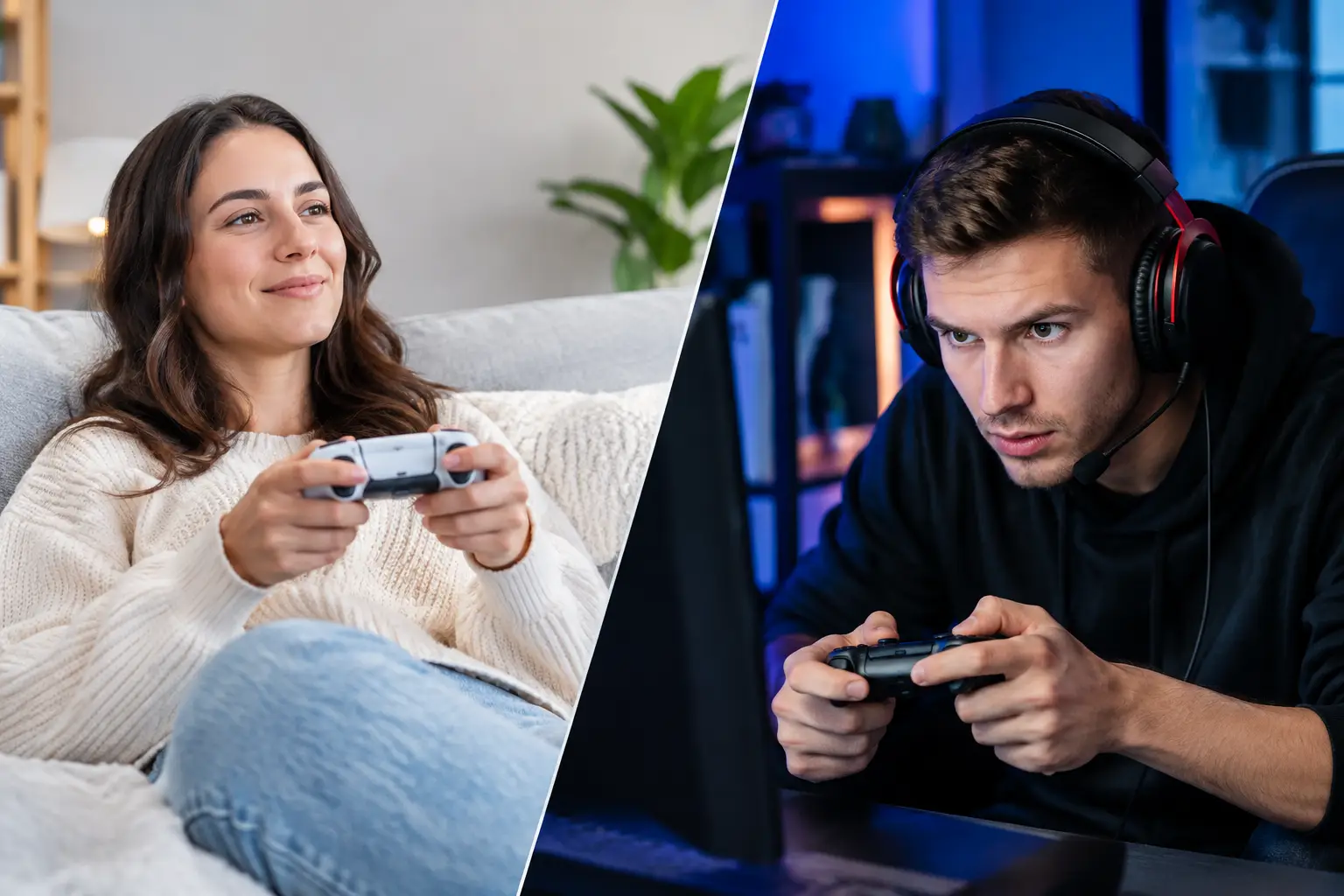
A game can ask for very little: one thumb, a spare minute and a small patch of attention between stations. Or it can ask for everything - quick reactions, a perfect plan and the willingness to lose three rounds before dinner. Relaxing games versus competitive games is not really a question of which is better. It is a question of what you want your play to do for you right now.
Both can be beautifully made. Both can create that bright, satisfying moment when a difficult action finally clicks into place. The difference is in the pressure around the action: whether you are following your own pace, or measuring yourself against a clock, a leaderboard, another player or your last attempt.
Relaxing games versus competitive games: the real difference
A relaxing game leaves room around the player. You might place shapes until a pattern feels right, find a word slowly emerging from a field of letters, or guide a small object through a calm sequence of choices. There may still be challenge, failure and discovery, but the game does not lean over your shoulder demanding an immediate answer.
Competitive games turn that pressure into the point. They often make each decision sharper by attaching it to a result: win or lose, first or second, promotion or relegation. That can be exhilarating. A close race, a well-timed move or a comeback achieved with seconds left can make a short session feel wonderfully alive.
Neither category is fixed. A puzzle with scores can become competitive if you chase the top of a daily board. An arcade game can be relaxing when you play simply to enjoy its movement and colour, rather than to beat a number. The important thing is not the label on the App Store page. It is the feeling the game encourages once it is in your hands.
When competition feels good
Competitive play is useful when you want a clear edge to the moment. It can focus a wandering mind. A one-touch challenge on the train may make the journey pass quickly because there is a simple target in front of you: get a little further, steer a little cleaner, react a fraction sooner.
It also gives progress a visible shape. Scores, ranks and streaks tell a tidy story about improvement. For players who enjoy practising a skill, that feedback can be deeply satisfying. The rules stay familiar while your understanding becomes more precise. A corner that once caught you out becomes a turn you can take almost without thinking.
There is social energy in competition too. Playing alongside friends, comparing a daily score or discussing a clever tactic gives a game a life beyond the screen. For some people, that shared friction is the fun. A win matters because somebody else was trying just as hard.
But competitive design has a cost. A game built around urgency can be a poor fit for the last ten minutes before sleep, or for a break that is already carrying too much noise. Losing may be entertaining on a free afternoon and oddly exhausting after a difficult day. The same mechanic can land differently depending on your mood.
Pressure is not the same as depth
A common mistake is to treat competition as proof that a game is substantial. It is only one way to create interest. A quiet game can have layers: systems to understand, small choices that compound, surprising combinations and a gentle curve towards mastery.
The distinction is whether that depth is offered as an invitation or a demand. A thoughtful word puzzle can ask you to notice a possibility you missed. A tactile placement game can reward patience and a good eye. Neither needs flashing warnings or a countdown to make the answer feel earned.
What relaxing games make space for
Relaxing games are particularly good at fitting around ordinary life. They can begin quickly and stop cleanly. You can play for two minutes while the kettle boils, then put the phone down without feeling that you have abandoned a team, broken a streak or wasted an entry fee.
That flexibility matters on a mobile device. Phones accompany us into small gaps in the day, but those gaps are rarely identical. One evening you may want an absorbing puzzle. The next, you may only have the attention for a few taps and a pleasing little burst of colour. A low-pressure game can meet you where you are.
There is also a different kind of achievement in player-led pacing. Instead of chasing the fastest answer, you notice the satisfying arrangement, the elegant route, the moment a cluttered board becomes clear. Progress arrives in small pieces. It is less about proving something and more about letting the answer come into focus.
This does not mean relaxing games must be easy. A difficult puzzle can be calm when it gives you time to think. An endless runner can be demanding while still feeling light, especially when restarting is immediate and failure is treated as part of the rhythm rather than a punishment.
Design details change the mood
A game’s atmosphere is not created by soft music alone. It lives in the details: whether buttons are clear, whether colours help you read the play space, whether a mistake can be undone, and whether the screen is crowded with reasons to keep spending attention.
Good tactile design gives an action a pleasant weight. Tapping, placing, matching or steering should feel direct. You understand what happened because the response is clear, not because the game has shouted about it. A clean interface can make a small mechanic feel like a tiny object you can turn over in your hand.
For many players, privacy and offline play are part of that calm. A game that does not constantly pull at the internet, interrupt a session or turn every quiet moment into a notification feels more like a game and less like a service asking to be managed.
Choose the game for the moment, not your identity
You do not need to decide that you are a competitive player or a relaxed one. Most people are both, at different times. The useful question is simpler: what kind of attention do you have available?
If you feel alert and want a crisp challenge, a score-chasing arcade run or a head-to-head match might be exactly right. If your thoughts are already crowded, choose something with room to pause - a puzzle without a timer, a colour-and-shape game, or a creative plaything with no wrong result.
It can help to notice how you feel after playing, not only while playing. Did the session leave you pleasantly sharpened, or did it make your shoulders tighten? Did you want one more go because the interaction was satisfying, or because stopping felt like failure? Those are small questions, but they reveal a great deal about a game’s fit.
A healthy games library often contains both. Keep one title for bright, competitive energy and another for a quieter reset. The first can turn a spare five minutes into a challenge. The second can turn the same five minutes into a little pocket of focus.
A quieter kind of reward
There is nothing lesser about a game that lets you slow down. Competitive games can offer brilliant drama, clean goals and the thrill of getting better. Relaxing games offer something just as valuable: a place where progress does not need an audience, and where a simple action can be enough.
Choose the game that suits the shape of your day. Sometimes that will be the sharp corner of a high score. Sometimes it will be a bright gap, a well-placed tile and the quiet satisfaction of leaving things a little clearer than you found them.