Hexagon Puzzle Games for iPhone Worth Your Time
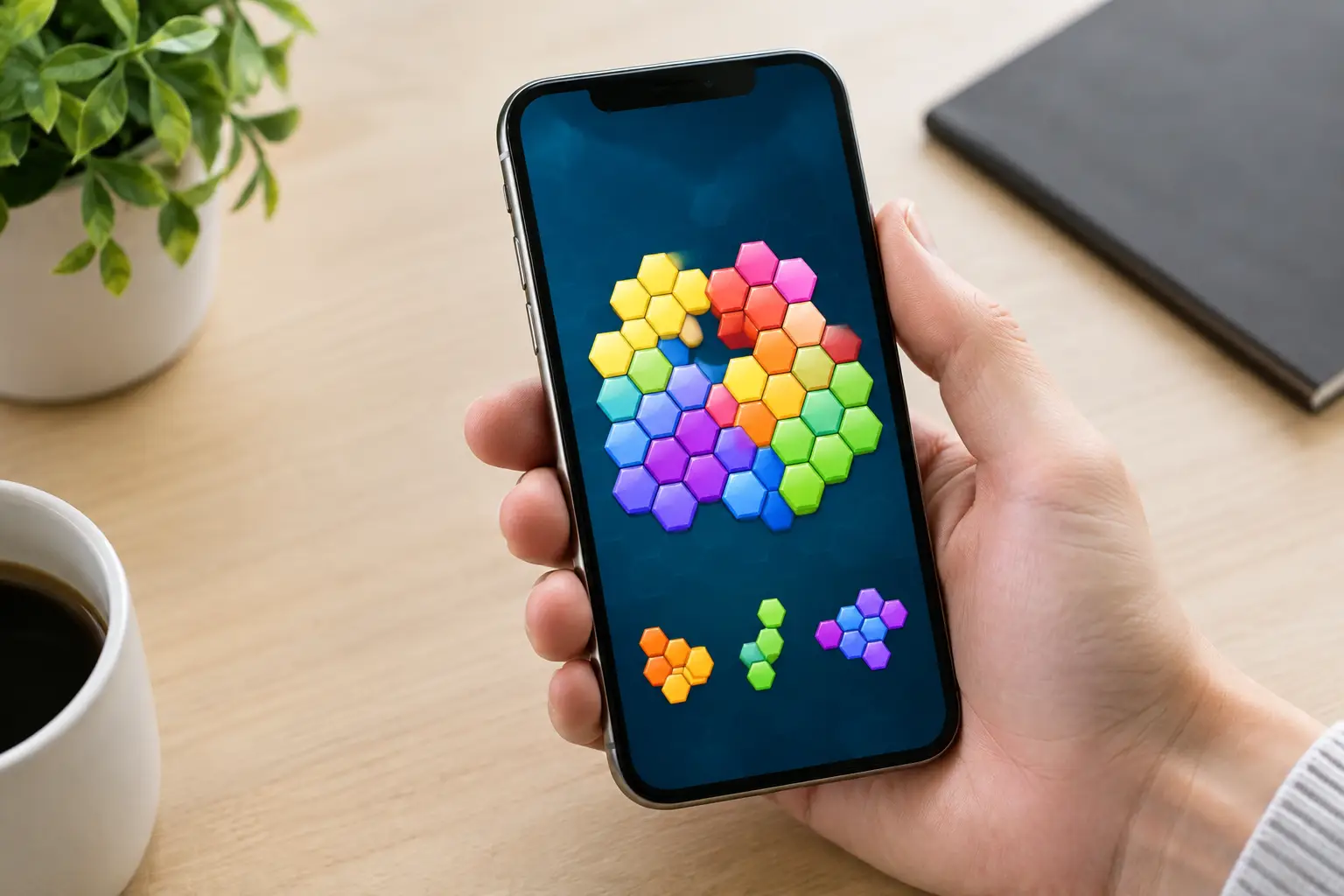
A good hexagon puzzle begins with a small shift in the eye. A familiar grid gives way to six-sided spaces, and suddenly every gap has more than one possible answer. The best hexagon puzzle games for iPhone make that moment feel inviting rather than intimidating: a few bright pieces, a clear board, and the quiet satisfaction of finding where a shape belongs.
They suit the odd five minutes particularly well. There is no need to memorise a long sequence of controls or commit to a multiplayer match. You look, turn an idea over in your mind, place a piece, and watch the board settle into a new pattern. That simple rhythm can be calm, sharp and surprisingly absorbing.
Why hexagons make a puzzle feel different
Square grids encourage horizontal and vertical thinking. Hexagons loosen that habit. Every tile has six neighbours, so pieces can connect on more angles and fill spaces in less obvious ways. A move that seems blocked at first may work after one small rotation. A narrow corner can become useful rather than awkward.
That extra direction is the source of much of the pleasure. Hexagonal puzzles ask you to notice outlines, negative space and the relationship between colours or symbols. They can feel spatial without requiring the deliberate, lengthy planning of a traditional board game. On an iPhone screen, where a clean layout matters, the honeycomb grid also has a natural visual order. It is geometric, but rarely stiff.
There is a trade-off. A dense board full of tiny hexagons can quickly become hard to read, especially on a smaller phone. The games that hold attention tend to make the board legible at a glance, then let complexity arrive through the pieces and the choices they create.
What to look for in hexagon puzzle games for iPhone
The category covers more than one kind of game. Some ask you to place clusters of hexagons and complete lines. Others are sliding puzzles, colour-matching challenges, path-building games or turn-based tile arrangements. The right one depends on what you want from a short break.
A board you can read in a second
Before a puzzle becomes clever, it should be easy to see. Look for distinct piece shapes, clear edges and colour choices that do not blur together. If the game uses numbers, icons or special tiles, they should add a useful layer rather than turn the board into a tiny dashboard.
Visual clarity is not merely decorative. It lets you spend your attention on the puzzle itself. When you can immediately spot a three-hex gap or a useful open edge, your next move feels like a decision, not a search for information hidden in the interface.
Controls that match the shape
Touch controls are part of the puzzle. Dragging a piece should feel direct, and rotating it should be obvious when rotation is part of the design. A gentle snap into place can make each move satisfying, while an easy undo gives room to experiment.
The most tactile games create a small sense of weight without getting in the way. Pieces should feel as though they belong on the board, not as though they are slipping around beneath your thumb. If a game uses gestures that are too fussy, even a clever system can lose its calm.
Enough pressure to create a choice
Not every puzzle needs a timer. In fact, a constantly ticking clock often works against the quiet appeal of shape placement. A limited board, a changing set of pieces, or a scoring system can provide all the pressure needed. The question becomes: what should I protect for later?
For some players, a score chase is exactly the point. Clearing a long line or setting up a chain reaction gives a quick flash of rewarding progress. For others, an endless mode with no failure state is more appealing. Neither approach is better. It depends whether you are looking for a focused challenge on the train or a slower puzzle for the sofa.
A respectful rhythm
The best small mobile games know when to step back. They let a session end cleanly, save progress reliably, and avoid interrupting a good thought with unnecessary noise. Offline play, a considered sound setting and an interface without clutter can make a real difference.
This is especially true for games played in fragments of the day. A puzzle should be ready when there is a bright gap in your schedule, whether that is before a meeting, while the kettle boils, or during a quiet evening. You should not have to negotiate pop-ups before you can make your first move.
Finding the puzzle style that suits you
If you enjoy arranging pieces until a whole board clicks into place, seek out placement puzzles with a finite layout. These often offer a pleasing sense of completion. Each level is a small object with its own sharp corners and hidden solution, and finishing it can feel like putting the last book back on a shelf.
If you prefer a game that can continue for as long as you like, score-based block puzzles may be a better fit. Their pleasure comes from keeping the board open, making space for unfamiliar shapes, and deciding when to take a modest clear rather than waiting for a perfect one. They reward patience, but they also allow a quick, imperfect session.
Colour-based hexagon games bring a different kind of attention. You may be matching adjacent tiles, making groups, or shifting shades around a honeycomb. These can be especially relaxing when the palette is restrained and the feedback is gentle. Too many effects can make simple colour relationships harder to see.
There are also route and connection puzzles, where you rotate hexagonal tiles to join paths, guide light or build networks. These favour local problem-solving. One tile affects its neighbours, and a solution often comes into focus gradually as the board becomes more coherent.
A calmer way to get better at them
Hexagon puzzles can seem to reward quick reactions, but a little patience usually pays off. Begin by looking for the most constrained spaces: small gaps, corners and areas where only one kind of piece could fit. Broad open areas can wait. This is the same reason it helps to keep the centre of a placement board flexible rather than filling it first.
When pieces can rotate, compare their outlines before moving them. Notice which sides are long, which corners are pointed, and where a shape creates an awkward notch. You do not need to calculate every future move. Simply avoiding isolated holes will make later choices kinder.
In a matching or merging puzzle, resist making every available move immediately. A quiet pause can reveal a larger group one turn away. That does not mean chasing the biggest possible combo at all costs. A reliable small clear is often more useful than a dramatic move that leaves the board cramped.
If the game includes an undo button, use it as a sketchbook rather than a rescue rope. Try the piece in one place, then another. Seeing why a move fails teaches the grid faster than waiting for the ideal answer to appear. The point is not flawless play. It is developing an instinct for the shape of a useful space.
Small details that keep a game on your phone
A hexagon puzzle may have only a handful of rules, so its details carry more weight. Sound should make a placement feel crisp without demanding attention. Haptics, if used, should be a light acknowledgement of a move rather than a constant buzz. A restart should be close at hand, but not easy to hit by accident.
Progress matters too, though it need not mean an endless ladder of tasks. A gently rising score, a new board pattern, or the private pleasure of improving a previous run can be enough. Thoughtful games leave room for the player to decide whether a session was successful.
That is the appeal of a well-made hexagon puzzle on iPhone. It turns a small screen into a little arrangement of possibilities. You can return for one board, one neat connection, one satisfying clear, then put it away again with the answer still pleasantly lingering in your mind.