Calm Word Games for Adults, Made for Quiet Time
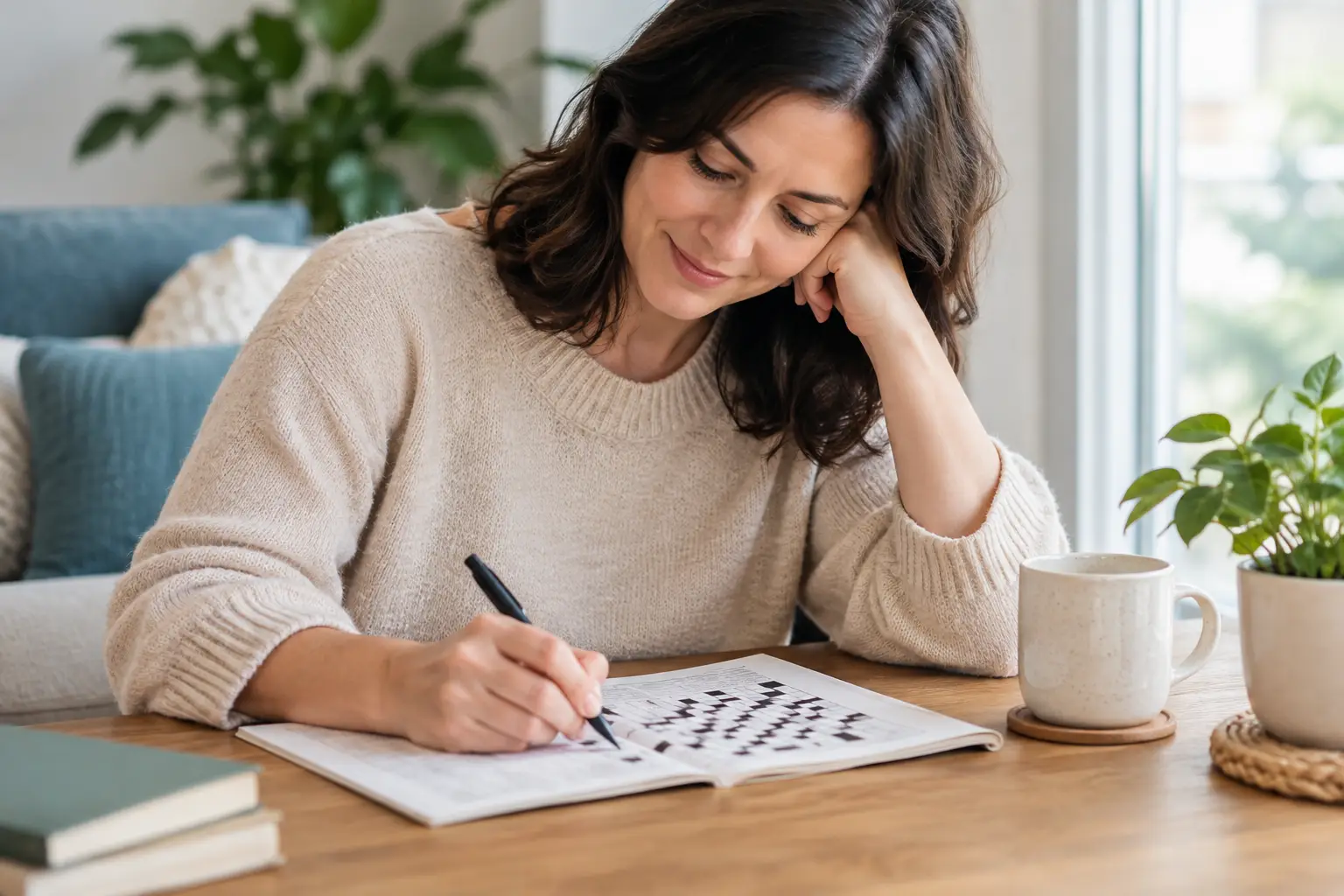
A half-finished crossword on the train can feel less like a puzzle and more like another demand. Calm word games for adults make a different offer: a small space to notice letters, try an idea, and let the answer come into focus. There is no need to beat a clock, reply to a team-mate, or keep up with a flashing screen.
For many people, words are already part of their quiet rituals. A book before bed, a note in the margins, the small pleasure of recognising an unusual phrase. A good word game takes that familiar material and gives it shape. It asks for attention, but not your whole evening.
What makes a word game feel calm?
A calm game is not simply an easy one. A puzzle can be properly challenging and still feel restful when it gives you room to think. The difference is pressure. If a game treats every pause as a failure, even a simple task can become tiring. If it allows a clue to sit for a moment, the same task becomes an invitation.
Pacing is the first part of that feeling. A word puzzle works well in a five-minute gap when it saves your place cleanly and does not punish interruption. You might play one round while the kettle boils, then return later on the sofa. Progress should be waiting where you left it, not demanding that you rebuild momentum.
Visual clarity matters just as much. Letter tiles, clues and word paths need enough breathing room to be read at a glance. A restrained screen does not mean a dull one. A bright gap between carefully chosen colours, a neat piece of type, or the soft click of a placed letter can make a small action feel considered.
Then there is consequence. Calm play benefits from gentle stakes. Wrong guesses can be reversible, hints can be available without embarrassment, and a lost round can still leave you with the satisfaction of having noticed a new word. The aim is rewarding progress, not the sharp little jolt of being told you have failed.
Calm word games for adults are not one thing
The phrase covers several kinds of play, and each creates a different sort of quiet. Choosing the right one depends less on your skill level than on the kind of pause you need.
For a slow, thoughtful break
Crossword-style clues and definition puzzles suit moments when you want language to unfold gradually. They reward memory, lateral thinking and patience. A clue may remain blank for a while, then resolve itself when you are washing up or looking out of the window.
These games can be deeply satisfying, but they are not always ideal when your attention is fragmented. A tricky clue can ask you to hold several possibilities in mind. That is lovely on a quiet evening and less useful on a noisy commute.
For a tactile little reset
Letter-placing and word-building games give the hands something to do. You slide, tap, connect or arrange letters, watching a scattered set become a recognisable word. The interaction is direct, and that directness can be calming. It is a bit like putting the last piece into a small wooden puzzle.
The best versions leave space for experimentation. You can make a short word, see what it changes, and try another arrangement. A game that turns every move into a race loses some of this gentle texture.
For a clearer head after a busy day
Word searches, hidden-word grids and pattern-based puzzles offer a more visual form of focus. Your eye moves across the page or screen, looking for a shape that suddenly separates from the surrounding letters. There is comfort in that repeated act of scanning and finding.
They can be especially good when you do not want to summon a large vocabulary. The task is less about recalling the exact word and more about noticing it. For some players, that makes the experience feel more like tidying a small corner of the mind.
For people who like a little discovery
Some word games make language feel playful rather than test-like. They ask you to combine fragments, uncover associations, or find unexpected words within a limited set of letters. There is still a puzzle to solve, but the pleasure comes from curiosity as much as correctness.
This style works beautifully when the game acknowledges unusual or less obvious answers. English is full of odd edges, borrowed words and cheerful exceptions. A calm game does not need to flatten that character in pursuit of a single perfect route.
The trade-off between calm and challenge
A game with no friction can become background noise. A game with too much friction can feel like admin. The sweet spot is a puzzle that asks enough of you to settle your attention, then gives something back for it.
That balance is personal. An experienced crossword solver may find a dense clue list soothing, while someone else finds it bristling with sharp corners. A word search may be too gentle for one player and exactly right for another after a day of decisions. There is no universal difficulty setting for calm.
It helps to look for games that let you choose your level of involvement. Short rounds suit spare minutes. A collection of puzzles gives you somewhere to linger. Optional hints are useful when they nudge rather than solve. If a game makes its harder modes feel like a natural next step rather than a gatekeeping test, it is more likely to stay welcoming.
The same applies to scoring. A score can provide a pleasing record of progress, particularly when you enjoy returning to improve it. But score-chasing changes the mood when every screen turns into a leaderboard. For quiet play, personal progress is often enough: a longer word found, a puzzle completed, a new favourite discovered.
Small design choices make a large difference
Mobile word games live close to everyday life. They are opened with one hand in a queue, in the few minutes before sleep, or between stops on the bus. That makes the details of their design unusually important.
A useful game starts quickly. It should be clear what to do before a tutorial has become its own task. The central action might be tracing a word, placing letters, or choosing an answer, but it should feel legible from the first screen.
It should also respect interruption. A phone call, a message or a low battery should not erase a promising line of thought. Saving automatically is a quiet kindness. So is working without a permanent internet connection, especially for underground journeys, flights and places where you would rather not be pulled back into notifications.
Sound deserves care too. Gentle audio can give a correct answer a satisfying weight, but it should never be the only way to understand what happened. Clear visual feedback serves everyone, and optional sound lets the game fit its surroundings. One person plays with headphones; another plays beside a sleeping partner.
There is a privacy side to calm as well. It is difficult to relax into a small puzzle if the screen is crowded with prompts, tracking notices and offers designed to interrupt the next move. A focused game keeps its attention on the letters. It does not turn a quiet five minutes into a negotiation.
How to make word games part of a gentler routine
The most satisfying way to play may be to give the game a modest role. Keep one puzzle for journeys, another for the last ten minutes before bed, or a simple word round for the pause between tasks. A game does not need to fill every spare second to earn a place on your phone.
Try stopping while the experience still feels good. Finishing a single puzzle can be more restorative than sliding into an hour of automatic next rounds. Leaving one clue unanswered is allowed too. Often the answer arrives later, unannounced, when your attention has loosened its grip.
If you share a household, calm word games can also be quietly social. Passing an iPad across the table for another guess creates a different sort of conversation from competitive play. There is room to compare odd words, laugh at a misleading clue, and enjoy being collectively stuck for a moment.
A game that leaves room for you
The best calm word games do not insist that you become more productive, more competitive or more available. They offer a contained little problem and a pleasing way through it. Letters become patterns, patterns become words, and for a few minutes the rest of the screen can stay still.
Choose the kind that suits the texture of your day: a clue that can simmer, a word grid that clears the head, or a handful of tiles that feel satisfying beneath your thumb. Then let the game be small. That is often where its quiet pleasure lives.